How it works

One invoice, five stages, one record.

Use the stages you need, in any order. Each one answers one question and adds to the same invoice record, so nothing is entered twice and the next stage starts where the last one stopped. Every invoice also joins the company's book.

  1. 01Plan & CommitBefore the order
  2. 02Register & SizeInvoice created
  3. 03Decide & ManageWhile it is open
  4. 04Deal & SettlePayment
  5. 05ProveCompleted

01 · Plan & Commit · Before the order

Price with confidence.

What rate can we plan on, and what must this price carry?

You do

  • Set a budget rate for each currency and period, with who approved it.
  • Enter the bank's rate for a quote you are about to give.

You see

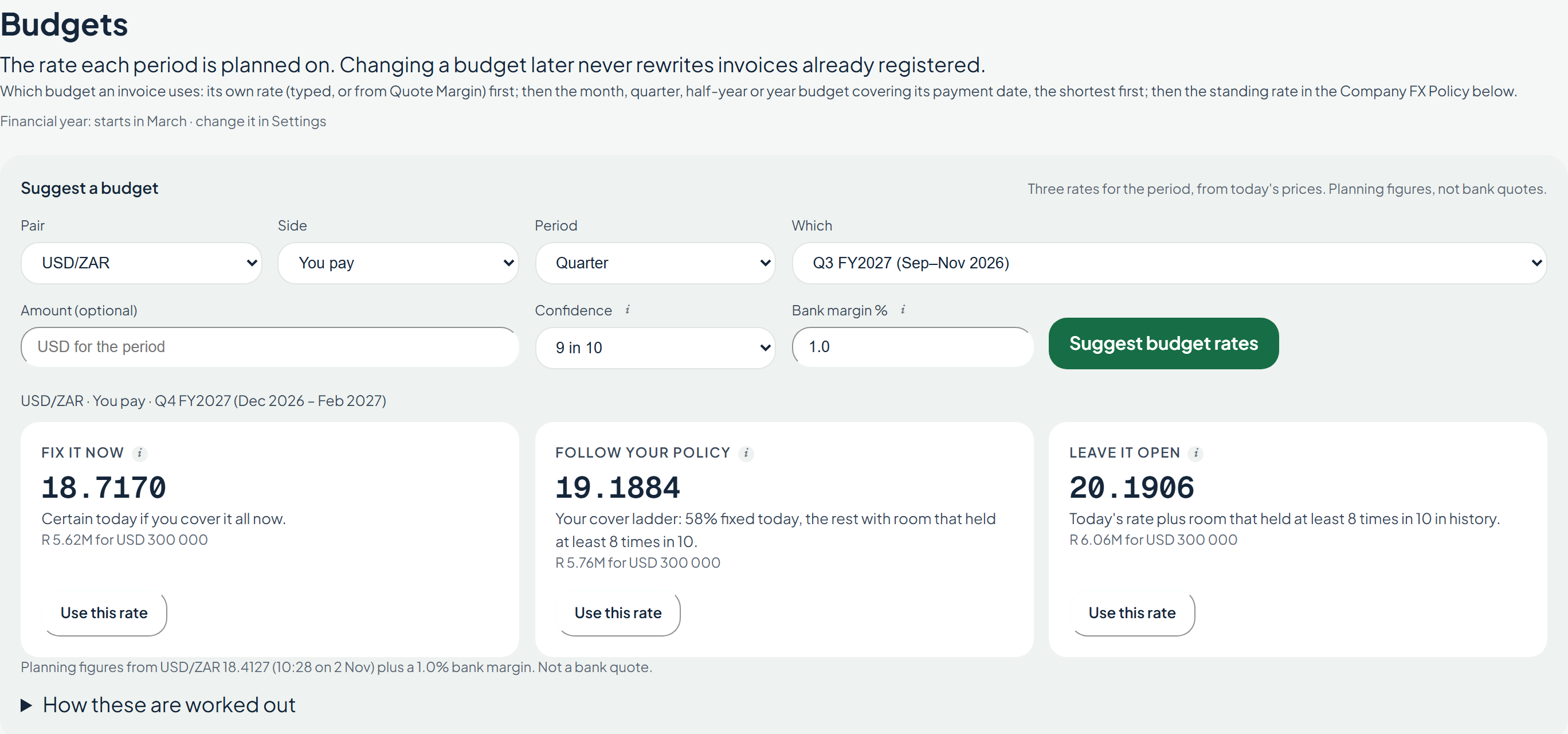
  • Three budget rates side by side: fix it now, follow your policy, or leave it open.
  • The FX allowance the quote must carry, Lean, Balanced or Strong, and the protected rate it gives the price.

Budgets · Quote Margin

Works on its own

Quote Margin needs no invoice. Price a quote today and register the invoice when the order comes.
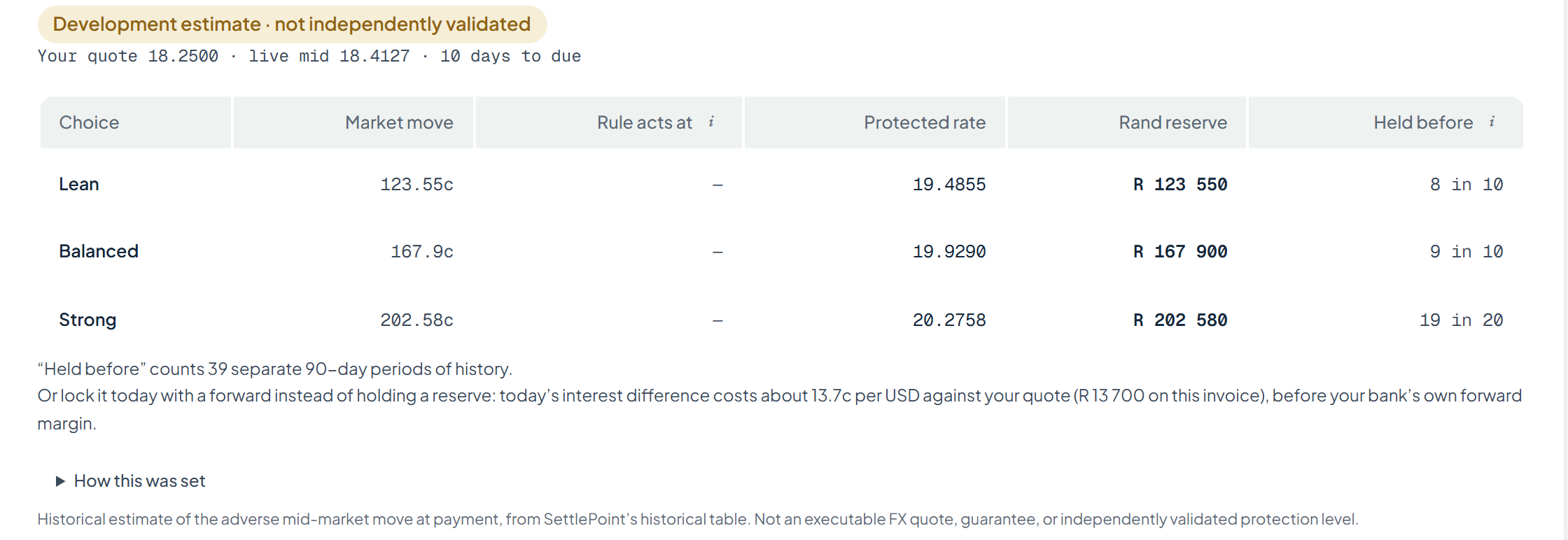
Quote Margin's three allowances, Lean, Balanced and Strong, with the protected rate and rand reserve for each
Quote Margin. Three allowances for one quote; your business chooses.
The budget planner: fix it now, follow your policy, or leave it open, each with its rate
The budget planner. Three rates for a period, from today's prices.

02 · Register & Size · Invoice created

Know what is at stake.

What are we exposed to, and what is at stake?

You do

  • Type an invoice in, or import a spreadsheet: currency, amount, pay or receive, due date.

You see

  • Its value in rand today.
  • The bad case (1 in 20) by the due date.
  • What locking it now would cost.
  • What your policy asks for, if you have one.

Invoices · Exposure

Works on its own

Use it as an invoice register with the risk on every line. Nothing else has to be set up first.
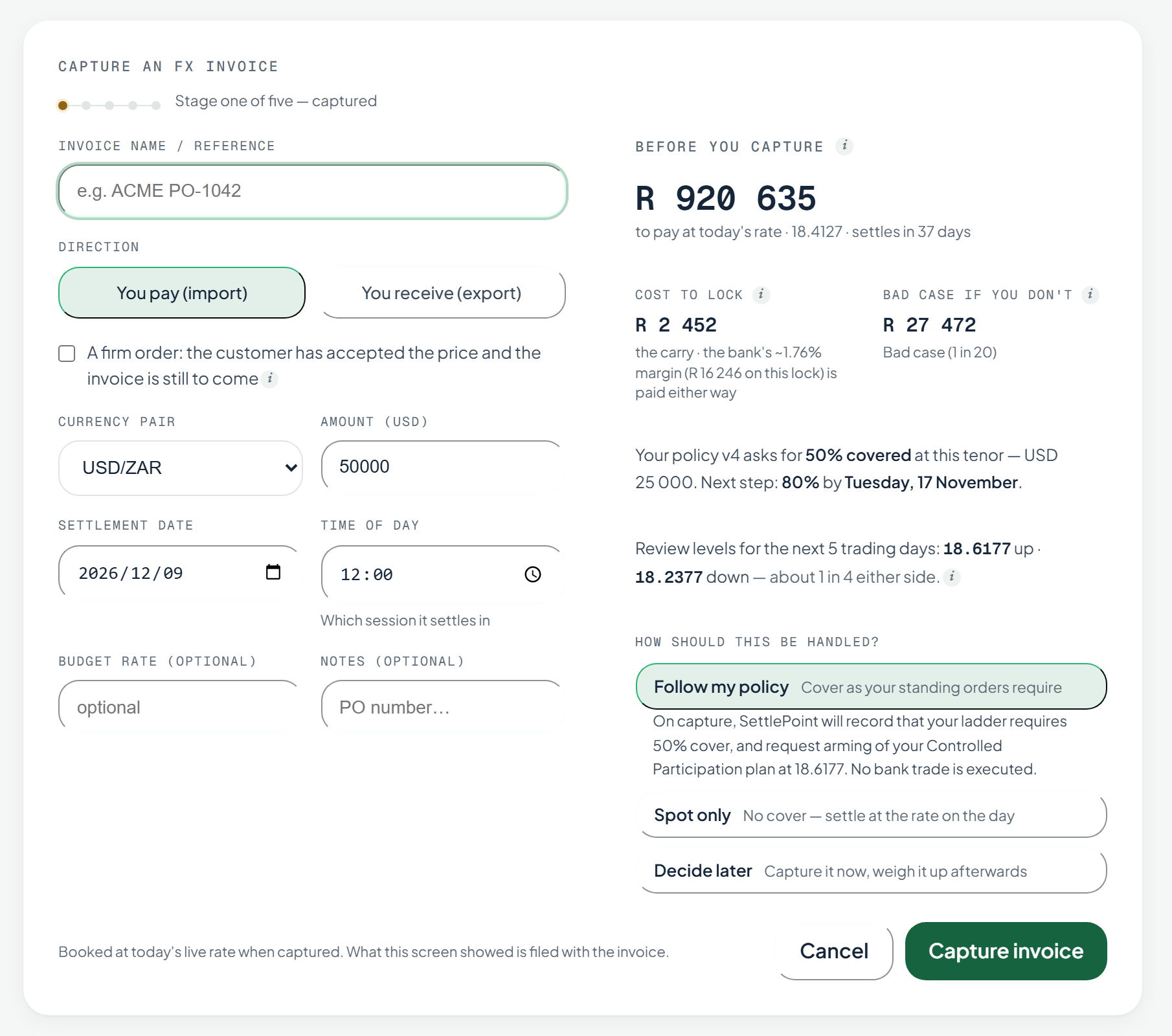
The capture form beside a preview: value today, cost to lock, the bad case and what the policy asks for
Capturing an invoice. The risk and the cost of locking, before you save.

The company book · Every open invoice

Every invoice adds up to one book.

What is due, what is covered, and what is still open?

You do

  • Nothing extra. Each invoice you register joins the book.
  • Name the person responsible for each invoice, if you want to.

You see

  • What you pay and what you receive, in rand at today's rates.
  • Each currency's covered and open amounts, and where payables and receivables offset each other.
  • What is due when, with what is already covered.
  • Who carries what, person by person.
  • The whole book's bad case (1 in 20), against the tolerance you set.

Reports · Responsibility

One book for the team

Everyone on your company's account sees the same book, so it no longer lives in one person's spreadsheet.
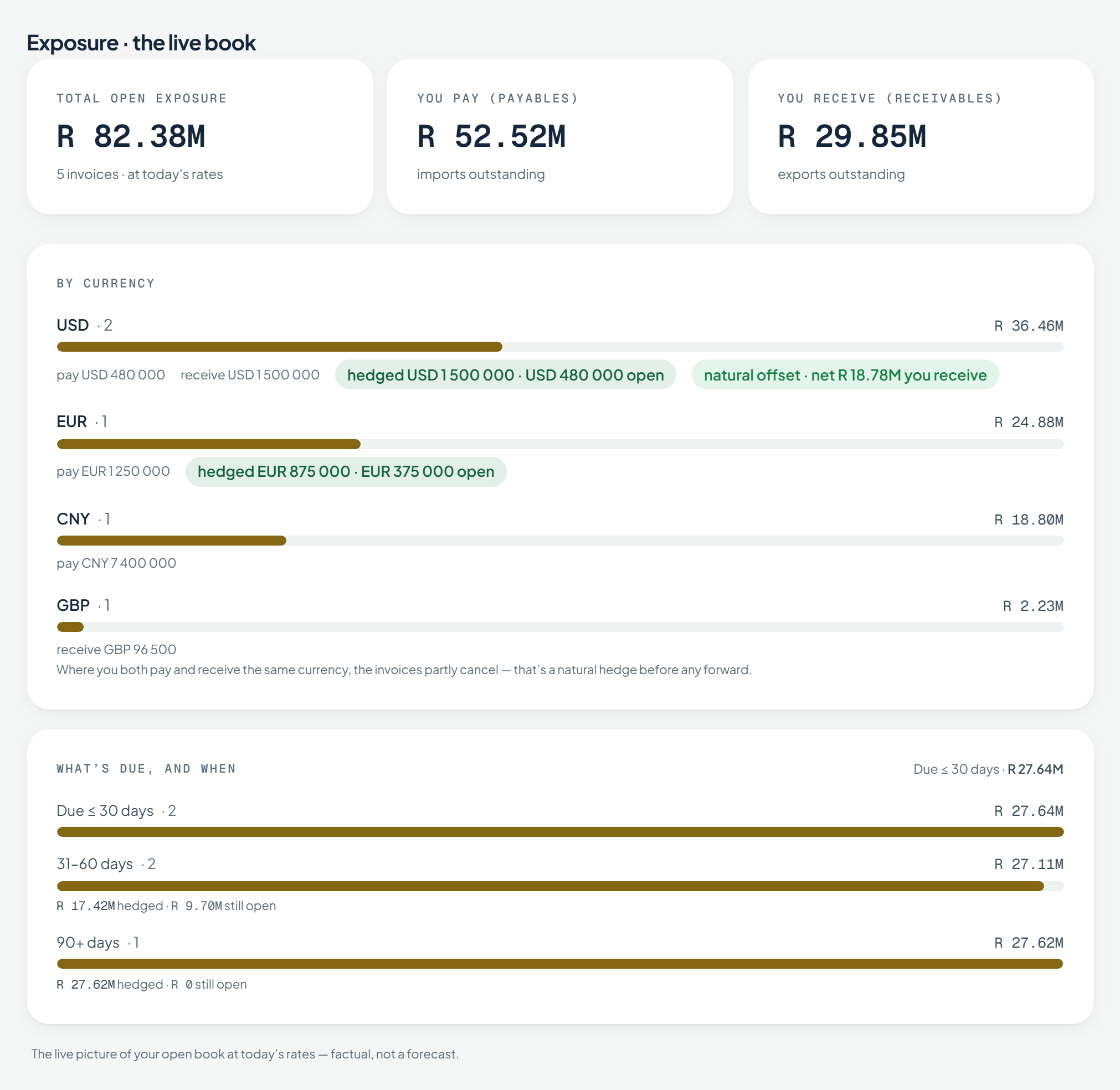
The book: total open exposure, payables against receivables, each currency's covered and open amounts with the natural offset, and what is due when
The book. What you pay and receive, each currency's covered and open amounts, and what is due when.

03 · Decide & Manage · While it is open

Choose how to manage it.

Which response applies, and does anything need me?

You do

  • Choose how each invoice is handled: lock it, cover part of it, leave it open under a Managed Spot plan, or follow your company FX policy.

You see

  • Lock now or stay at spot: both roads priced from stretches like this one in the rand's history, with the same bank margin on each.
  • Margin Watch: how much of the allowance the market has used, and when your rule says to act.
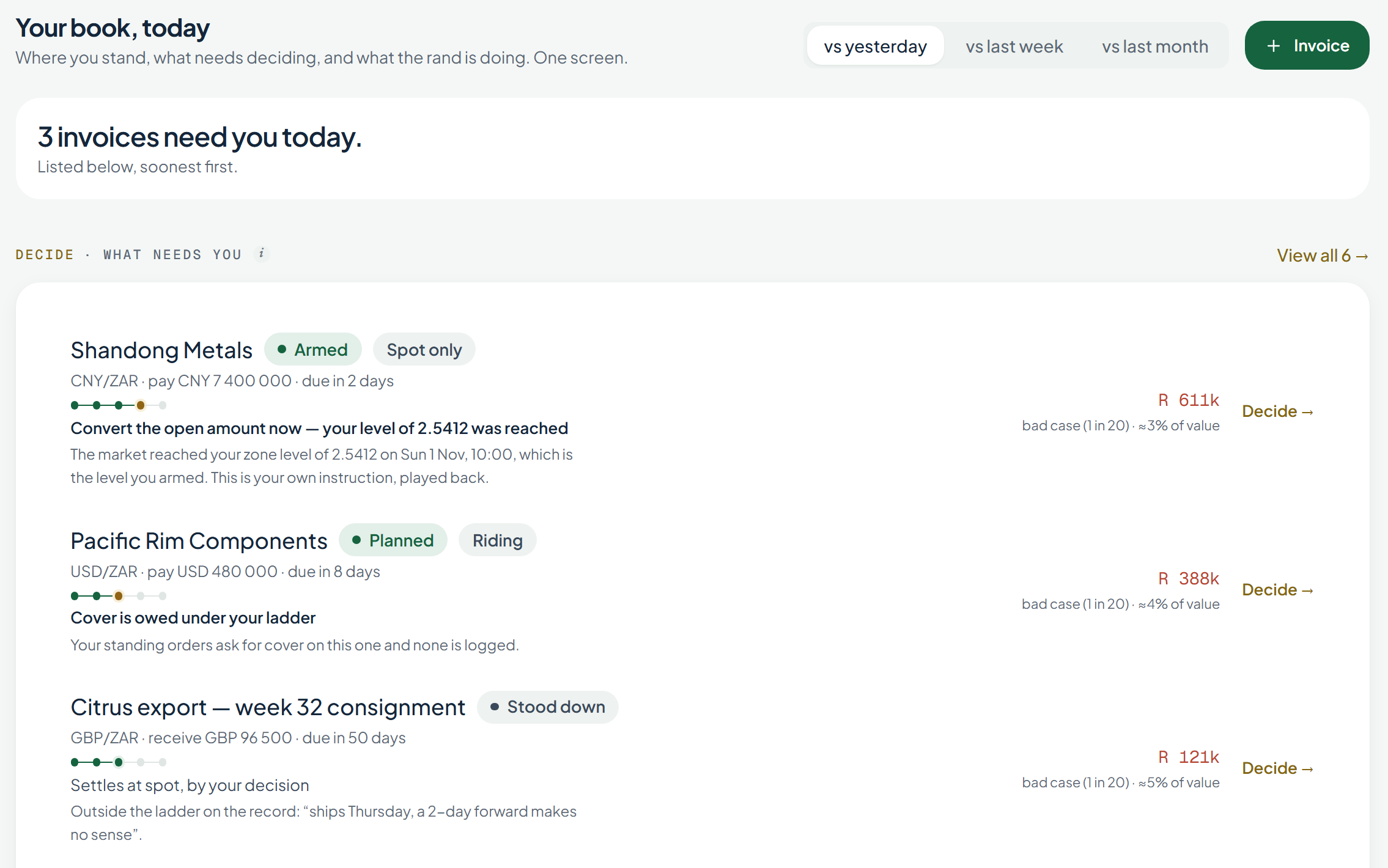
  • Today: one item per invoice, only when something needs you, with its reason.

Lock now or stay at spot · Margin Watch · Managed Spot · FX policy · Today

A policy is optional

Managed Spot and Margin Watch can be chosen invoice by invoice. A company policy, when you write one, applies them for you.
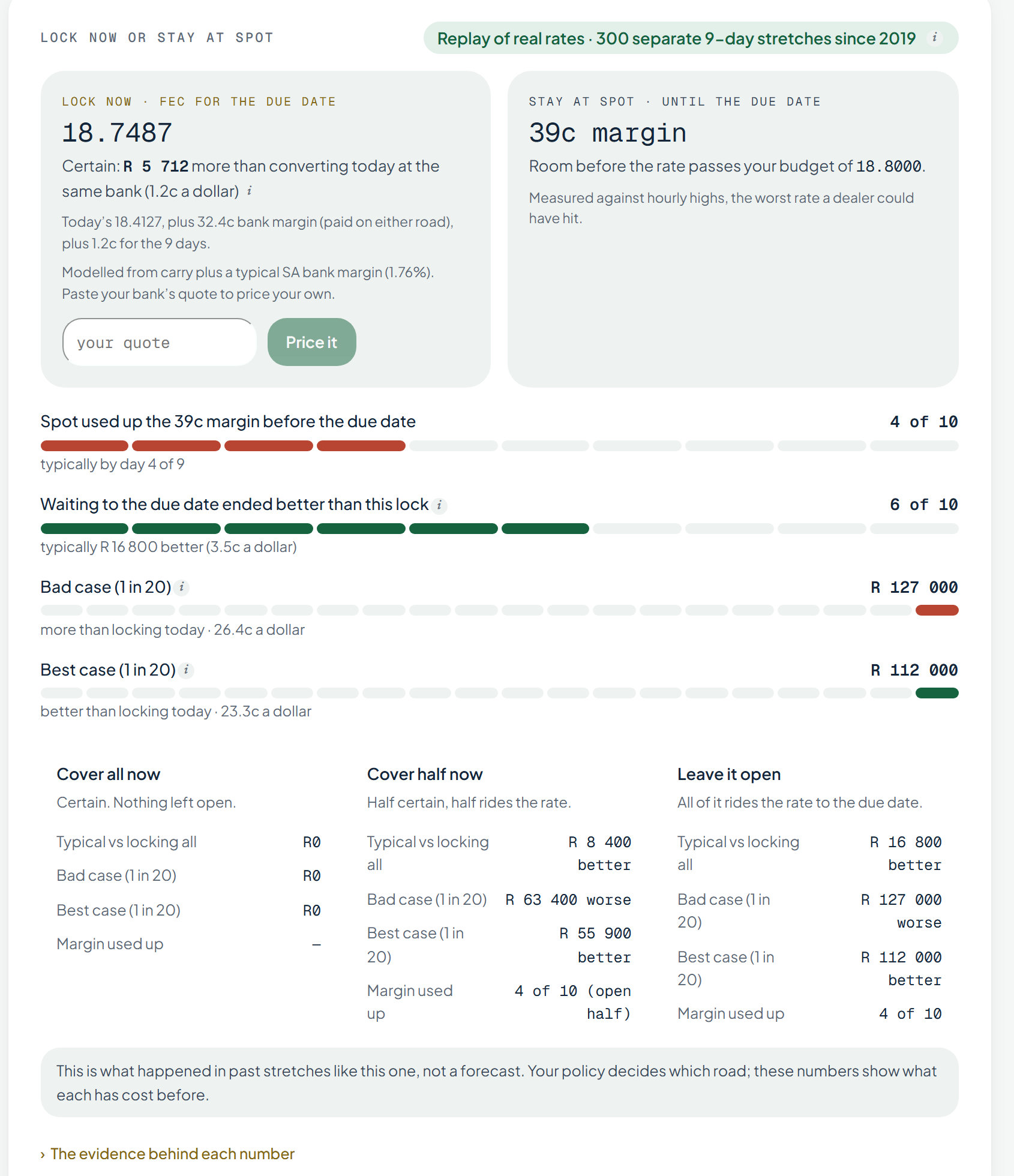
Lock now or stay at spot: the certain cost of locking against the room before the budget, with how past stretches ended
Lock now or stay at spot on one invoice. History, not a forecast; your policy chooses.
Today: the invoices that need a decision, each with one action and its reason
Today. What needs you, soonest first.

04 · Deal & Settle · Payment

Know what you're paying.

Is this the right price, and what did it cost?

You do

  • Paste the bank's quote before you accept it.
  • Record what was dealt: rate, date, time and fee. Deposits and part payments too.

You see

  • The margin inside the quote in cents, percent and rand, against a fair forward you can recalculate.
  • Each conversion graded against the market at the hour it was dealt. A measurement, never a saving.

Bank Check · Settlement

Works on its own

Bank Check is free and needs no login. Check a quote →
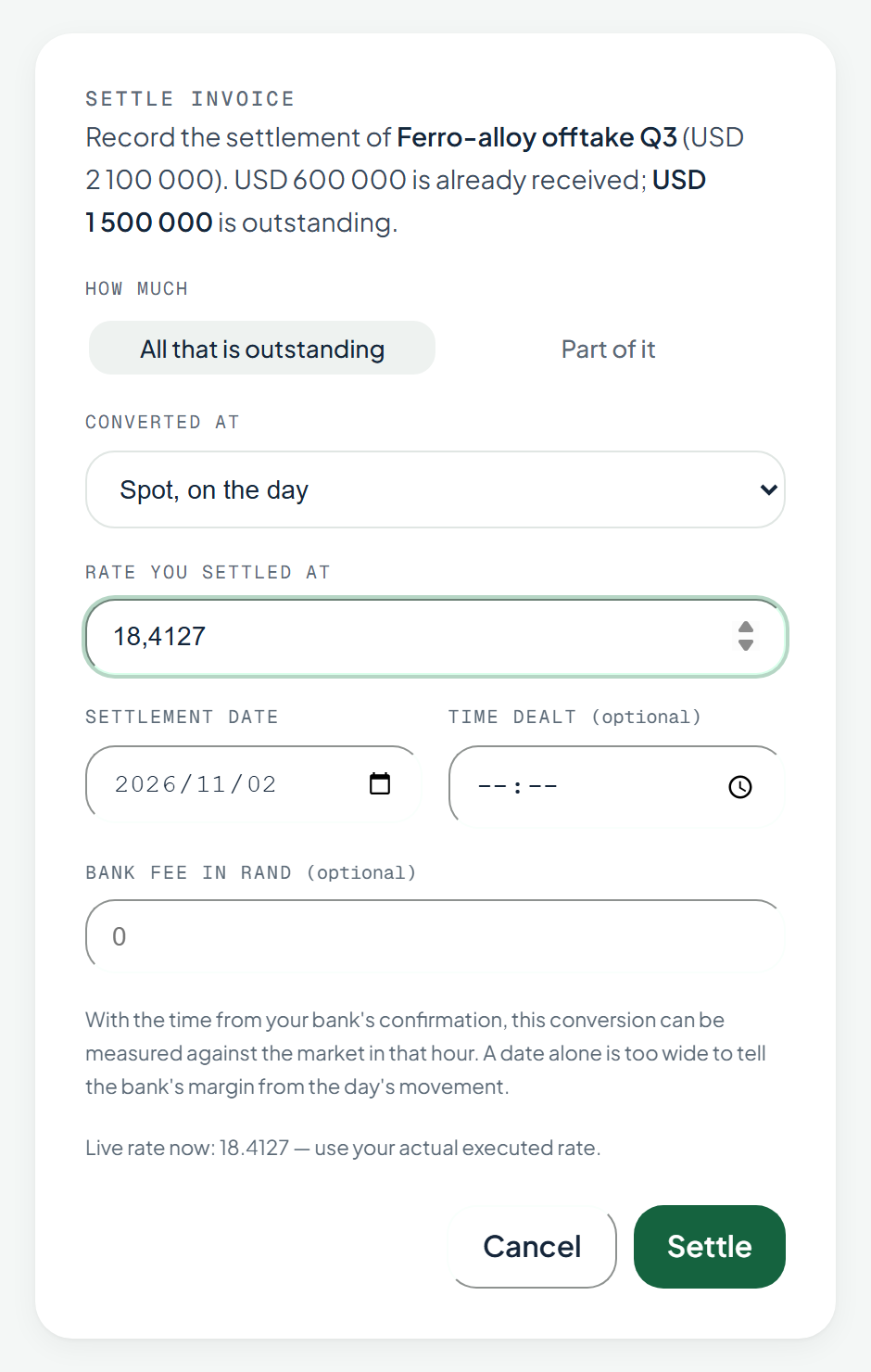
The settle form: how much, converted at, the rate, the date, the time dealt and the bank fee
Recording a settlement, with the time that lets it be graded.

05 · Prove · Completed

Understand the outcome.

Can we defend it, and what do we change?

You do

  • Nothing extra. The record builds itself from the stages you use.

You see

  • The Outcome Record: the decision, who approved it, what was shown at the time, and the result.
  • A monthly pack for the board, kept exactly as it was issued.
  • The budget tracker: where each budget stands against its invoices.

Outcome Record · Monthly pack · Budget tracker
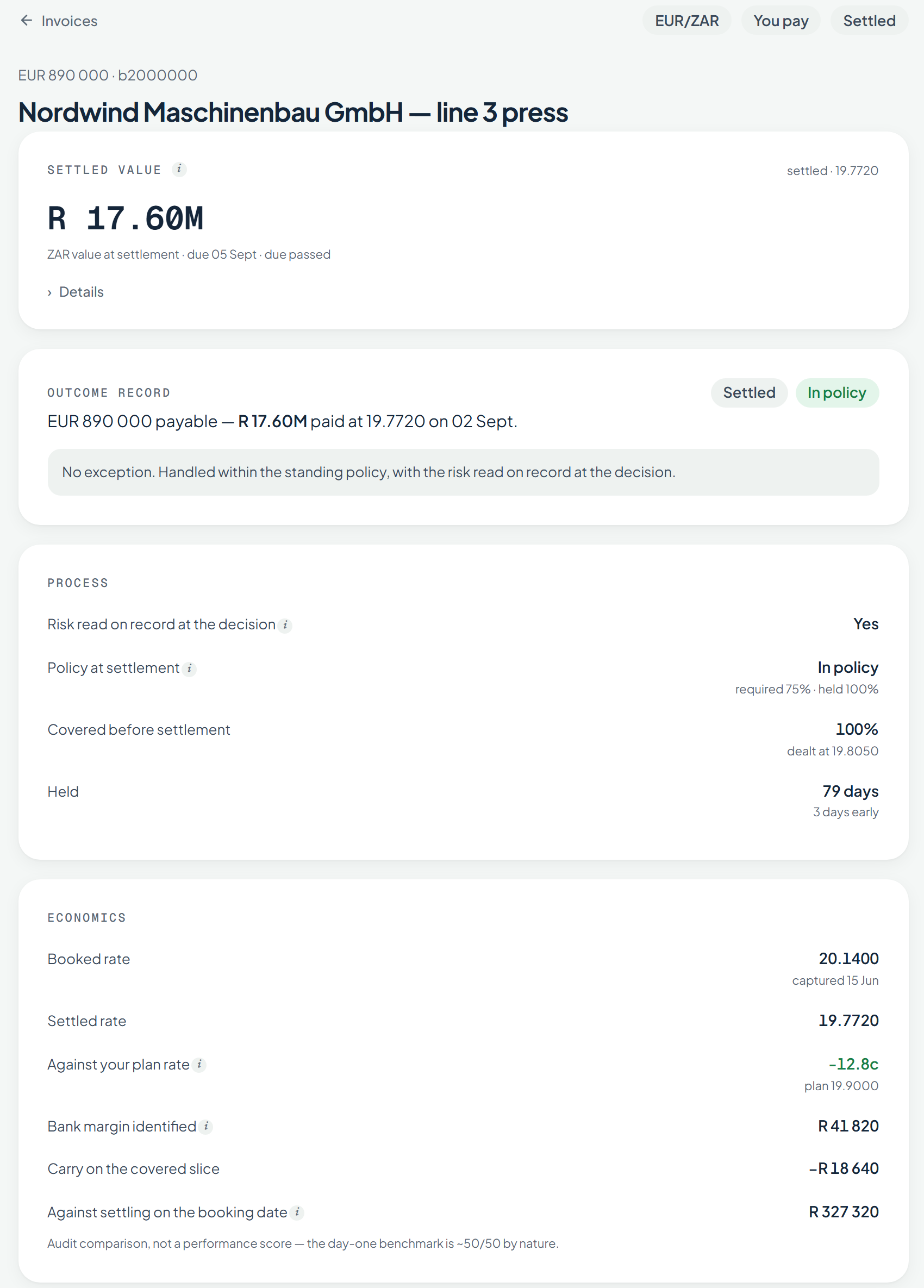
The Outcome Record: settled value, the decision on record, the process followed and the economics
The Outcome Record for a settled invoice.
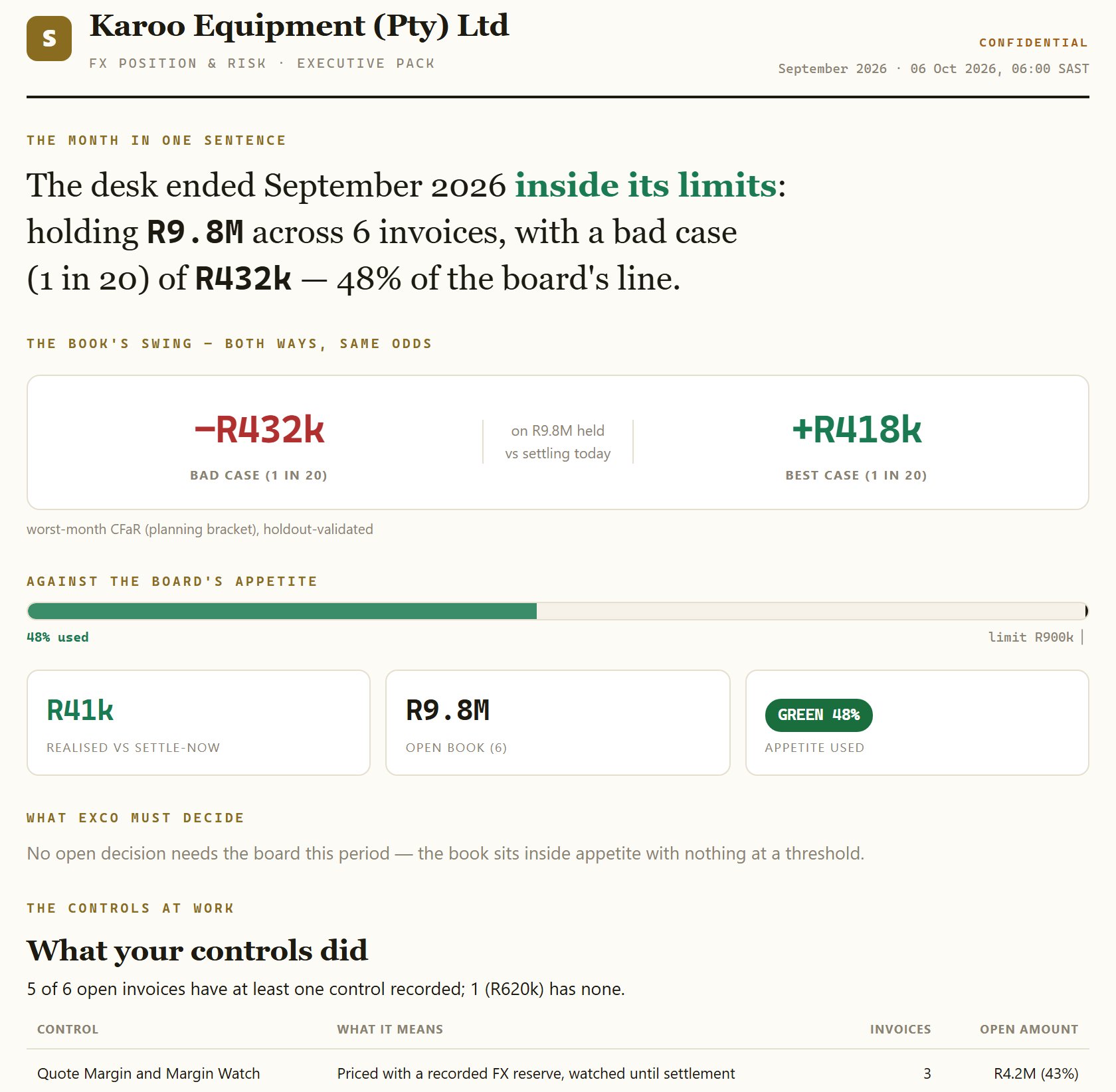
The monthly pack: the month in one sentence, the book's swing, appetite used and what the controls did
The monthly pack, for a sample client.

Where to start

Start with the decision in front of you.

Begin with one job. Whatever you start with stays on the invoice's record, and every invoice adds up to the company's book.

Start anywhere

Solve one FX problem.

Check a bank quote, price the FX allowance into a quote, or add one invoice.

Check a bank quote, free →

One invoice

Work one invoice.

Its due date, its value in rand, what is at stake, what is covered, and the plan working the rest.

See the decision →

The company book

See the whole book.

What is due and when, in each currency, and who owns it. What is covered, what is open, and what needs attention.

See the book →